
Aug. 14, 2026
Keep It Together:
The Imaginary Science/Spirit Split
It began in a creeping misunderstanding. The pioneering work of Francis Bacon and Galileo was never intended to dispense with religion, but rather to sort the proper methodologies with which to know God and the natural world. What was meant as a distinction became a crack, wedged further open with Darwin’s work on evolution. Both sides dug in – theologians closing ranks, scientists claiming ground that was never theirs to take. Conversation around science and faith became a zero sum game. Who would have imagined that the re-enchantment of the spiritual would come from the side of science?
The irony, of course, is that for millennia belief in God was supported by the desire to understand the world. Surrounded by natural phenomena that appeared sometimes orderly and sometimes random, a divine power was invoked to account for the inscrutable workings of the world. In fact, Bacon and Galileo share fame for reviving the “Two Books” metaphor, the belief that God gave humankind two books – the Book of Scripture and the Book of Nature – in defense of the emerging scientific enterprise. The study of the physical universe was for them a path to know God in new ways. And so it remained for centuries.
The eighteenth-century Enlightenment is usually blamed
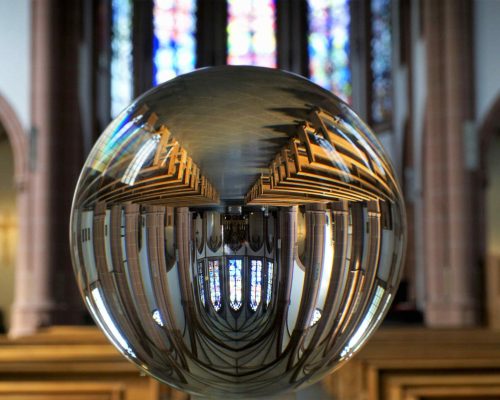
for launching the shift toward science and away from religion, but even then the aim was to reform religion in the light of new empirical discoveries rather than to expel it. But scarcely a century later, evolutionary theory trespassed into the terrain of creation by divine design to threaten the conceptual scaffold that had been holding an advancing science and a static religion together: the idea that something or Someone was in charge and directing the whole show. When applied even to humans, religion called foul and left the conversation.
But science overreached. The pace of its advance into domains invisible to the naked eye led it to believe that given ample time, it would conquer everything. A public yearning for control over disparity and suffering signed on to the project, sacrificing meaning and value to its promise, and mystery was lost from both fields. In losing each other, religion and science lost the foundation of both.
The Book of Nature
At the swift pace it was progressing, however, it didn’t take all that long for science to run up against its own limits. The changes that swept the world from the mid-1800s, when Darwin’s work was published, to the early decades of the twentieth century, were outpaced by the revelations emerging from the dawning field of quantum mechanics. Vast improvements in tools for observation disclosed dimensions of matter and energy previously unimaginable, and the deeper scientists took their inquiry, the more elusive the true nature of the world appeared. In 1928, English astrophysicist Arthur Eddington captured well, and a bit humorously, the spirit of the nascent field of quantum mechanics: “Something unknown is doing we don’t know what – that is what our theory amounts to.”
Eddington’s contemporary, Werner Heisenberg, provided a marginally more useful theory: that observation doesn’t just measure reality, but partly constitutes it. It remains just as difficult to know what to do with that view – now supported by a century of further research – as it was then. The control over the physical world that had seemed tantalizingly close, in a few decades slipped further away than ever.
It was not, of course, what anyone expected. The rigorous minds and optimized instruments that had driven the field were forced to pause. A venture into the unknown that had previously marched steadily forward was thrown into disarray by the new data, and abruptly lost its bearings.
Not for long. For it is the nature of knowledge, and particularly of the sciences, to press ever forward. Intimations of something that might lie beyond measurement did not prevent intrepid intellects from pushing ahead to know as much as they could. To speculate and postulate. And to imagine, even if it took them into territory that the religious sought to own.
The Book of Scripture
How different religion’s posture has been. While science and religion shared the aspiration to perfect understanding of the laws that move the universe, the field that saw its focus as finite has been more open to ongoing inquiry than the one whose sphere was deemed by nature infinite. In tracking a God seen as thoroughly transcendent, religion offered its final word.
There is arguably more riding on it, of course. Science pursues knowledge of this world; religion’s terrain is the inconceivable totality of the entire divine enterprise – this world and the next as well as just what God really is. It is understandable that we should want that greater site of our being to offer security, reassurance of our value. Particularly at a time when science seems to be pulling the rug out from under us.
Perhaps too there is just a bit of egoism in religion’s bid to have the last word. That we possess a unique skill of language in which to relate our boundless experience of life and in particular that which we have singled out as “spiritual” may have made us oblivious to the degree to which all of life participates in an indivisible wholeness. Organisms from cells to trees to marine life to higher mammals possess an undeniable wisdom of being that serves life, and that we are as far from grasping as we are from the ground of our own minds.
I recall the hoopla created in the mid-1970s and early ’80s by a number of books that attempted to draw clear lines from the spooky discoveries coming out of quantum physics to the witness of mystics throughout the ages. Suggestions of a shared source may have been legitimate, but claims that the science proved the spiritual were not. The growing marginalization of religion would find no rescue there.
Still, the effort itself seems a bit backward – the endeavor that seeks to understand the entire created order and its Creator, reaching for evidence from just a portion of it. Surely the vision offered by religious interpreters has not been expansive enough. Perhaps it can take a lesson from the insatiable search of science.
One Story
Science will never “prove” God or any reality that meets our operating definition of the spiritual. But neither need science be – nor even can it be – banished from the consideration of ultimate things. And it can in fact restore to us something that many traditional theologies have lost.
That is, that there is an inescapable unity to all that is, that the spiritual cannot be divorced from the physical, that creation is not something other than its Source. However we may conceive of such as Source or Ultimate Reality, the evidence of quanta and mystics alike points to our nature as part and parcel of it. Call it what you like – God or Source or Ground – what the mystics knew in unitive divine experience and what the physicists bump into as the “observer effect” both suggest that there is no reality anywhere that is divorced from the person who witnesses it. The seer is part of the seen, even when what is seen and known is God.
Perhaps that is what Einstein intuited when he submitted that the “cosmic religious feeling” is the strongest and noblest motive for scientific research. He is not saying that such research will find God, but that the quest to understand the world is not a separate quest from the spiritual. That the adventure to know who we are and our place in the universe cannot be pursued with anything short of our full being, nothing less than the shining of our consciousness through every facet of Being.
That refraction of light may be precisely the point. The universe we inhabit – teeming with the seen and the unseen, the mapped and the yet to be discovered – can never be held in the palm of one hand. No one path, no single pair of eyes, no set of formulas scientific or theological, will ever be able to capture the truth of the infinite or any discrete part of it. The fullness of its mystery will always hover somewhere just beyond what we can see.
Both science and religion are drawn by the mystery that beckons, asking to be revealed. Yet to the degree that either path believes there is a full and final answer to be found, both will fail. And to the degree that either science or religion seeks to heavy-handedly impose its partial, still progressing truths upon the world, it will contribute to the very suffering and injustice it seeks to heal.
Perhaps the real challenge, to both science and religion, is the myth that there should be a final answer. Virtually every religion on the planet is grounded in a belief that the nature of Ultimate Reality, of God, is infinite. The theories arising from the far reaches of science posit dimensions of our universe and the potential for other universes so vast that they might as well be infinite. What would a “final” answer in an infinite universe even look like?
And ask anyone on an authentic spiritual journey, and you will know that there is no fixed, solid, static posture of faith: that one believes, and stumbles, and knows and grows. Pick up any book on science and you will know that science too goes through intervals of growth and regress, missteps and surges. No end has so far been discerned by either. The adventure continues to unfold, regardless of our desire for certainty. Perhaps certainty is our desire, not God’s. Perhaps stability is our agenda, not the universe’s.
During the same period that a handful of science writers were attempting to collapse science and spirituality into a single simplistic mechanism, there were other voices that invited reflection in another direction. Among them, astronomer Carl Sagan was widely embraced by the public not only for his ability to make complex concepts accessible to a lay audience, but for his contagious delight in his subject. With unwavering scientific rigor coupled with inexhaustible wonder, Sagan unlocked new realms of imagination with the power to transform humankind’s knowledge of itself, its limits and its potential, its history and its future.
In his 1994 book, Pale Blue Dot, Sagan issued a challenge, and an invitation, to those on the side of religion, to meet him in science’s camp: “How is it that hardly any major religion has looked at science and concluded, ‘This is better than we thought! The Universe is much bigger than our prophets said, grander, more subtle, more elegant?’”
In the end, it is that more that we are after, isn’t it? Yes, it’s the more.
We’d love to hear from you, please share your comments with Kaira below.