
Nov. 18, 2026
The Hinge of Plenty:
An Economy of Blessing
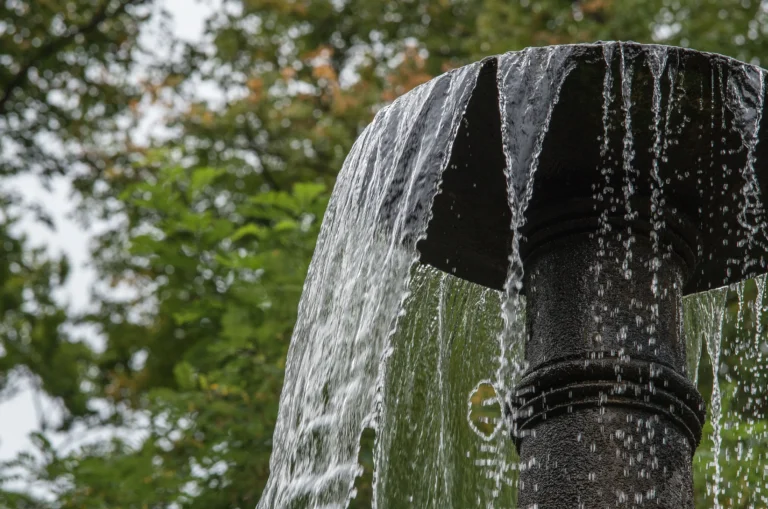
We human beings have a rather fraught relationship with blessing. We are taught that God blesses, but much in life eludes that label. Even as we count our blessings, we know that some have more of them and others have fewer. And while a share of the dilemma may come down to how we parse the flow coming our way, the true test, and the key to passing it, may lie in where we position ourselves in relation to the stream of life.
For most of Western history, philosophies and theologies were built upon the framework of biblical creation accounts. But while the knowledge that creation is good and varied and plentiful was foundational—the blessing that begets all blessings—that is perhaps where agreement ended. Even the two separate reports in Genesis don’t agree on much more than that. From the get-go, we are offered a choice: not between the good and evil that has driven themes of theodicy and redemption and teleology, but about how we understand who we are.
Pastors in pulpits have for generations done their best to smooth over the differences in the two distinct creation myths that stand at the opening of the Judeo-Christian scriptures, but scholars have known for more than two centuries that they were written in two distant epochs, from within dramatically disparate experiences and worldviews. And once we recognize that the version with which the Bible opens is actually a later rendition than the one that follows it, the stage is set for the kind of scramble that has lately handed us a new, and urgent, interpretive task.
The older narrative comes to us from around the tenth century BCE, and is grounded in a relatively peaceful, secure, agrarian period in Israel’s history, the golden age of its monarchy. It moved within a worldview in which God and creation were intertwined, mutually present and purposeful. Though humankind clearly had a hallowed place in the holarchy of living things, its function—its responsibility—was yet nested within a single divine cosmos. Just so does this early story recount the very first divine command to the man God had freshly created: to care for his home, Eden.
By the time of the other account just a few centuries later, the landscape was utterly changed. The kingdom had been conquered; the Temple had been destroyed and the people exiled to far-off Babylonia. The outlook was dismal, its pastoral history a distant memory. But it was also the Axial Age, that phenomenal period now considered to have carried a flowering of human consciousness that launched humankind into radically new knowledge of itself and its selves, and toward a potent and intentional agency in its relationship with the world from which it emerged. This is the story that cast us in the image of God, the crown of creation.
And the one that got us in trouble. Humanity has a consistent track record of forgetting the wisdom of the old in the excitement of the new. And even as Israel’s emerging consciousness rose up to meet the challenge of its survival under domination, it is no surprise that the affirmation of power took center stage. And gave us the language of dominion.
A Fractured Story
In our present time of ecological crisis—indeed, of a crisis of meaning—many have sought to soften the traditional translation of the Hebrew radah as commanding human dominion over creation, recasting it as a call to stewardship more in line with the earlier creation myth. But that is a stretch. Radah itself implies neither benevolent nor despotic rule, and the kavash that sits beside it sounds a clear note of bondage, even a “trampling down.” Maybe the “dominion” translation doesn’t seem so bad after all.
I don’t need to outline for you the damage that has been done by particular applications of this text read as literal and inerrant. But the greater harm, to both ourselves and others—and to the world that is our home—may have come from our misappropriation of the imago dei, the image of God that singles us out not as better or smarter or more valuable than the rest of creation, but as responsible for its life, for our life, for God’s life.
The scriptures of every great spiritual tradition have been carried through the ages by the wisdom they incarnate. Yet if we are now—from a modern vantage informed by history and science and metaphor and allegory—able to discern the maturing of consciousness, the growth of wisdom over humanity’s journey, we must honor scripture not as a literal and unchangeable record of an absolute and unchanging reality, but as a chronicle of many people’s efforts over centuries to flourish within a dynamic and developing Reality. A Reality whose exploding knowledge of a distinct and potent self was born from and borne within the greater harmony of a creative whole.
We stand both in the midst of and at the front of the chorus of blessing that is creation. Among the unnumbered beings who enjoy and participate in its life, humans alone are gifted with the capacity to welcome it, to be thankful for it, to love it as we have always been told that God loves it. To care for it, to steward it.
A Servant Story
Stewardship remains an inextricable part of the Jewish worldview; it retains the same sense of the divine/human care for the world so humbly but centrally portrayed in the early creation story. The world in which Jesus grew up was built upon laws that honored and protected every aspect of life, not only the human and not just the spiritual. While first-century Jews knew themselves as carriers of God’s image, that awareness was gathered into the role of custodian, of caring for and returning to God that which was God’s.
And truly, this parable falls in a section of Matthew’s gospel that outlines the consequences of unfaithfulness. It would seem to have its roots more deeply in the wrathful God often portrayed in Israel’s early stories than in the loving God we associate with Jesus. Yet framed within Jesus’s sweeping invocation of the kingdom of God, this parable cuts to the very heart of the human commission.
The servant who failed did not squander the master’s fortune; he was not even careless with it. He simply did nothing, and waited for the master to return and retrieve what was his. He failed to take up his role in the master’s household. In a static world that waits for redemption, maintenance may be sufficient. But that was not the kingdom that Jesus resided in, it was not the kingdom he offered, it was not the kingdom he inaugurated.
A Mislaid Story
It is hard to imagine the Hebrew priestly writers believing that Israel’s covenant with God justified or even demanded the trampling of the created order for its survival, no matter how desperate the circumstances. Or is it? Any perception of privilege—even a divine one—is susceptible of incalculable seductions. Manifest destinies, unlimited technological horizons, lights on hills extolling the virtues of our own productions.
How did the movement that claims Jesus’s teaching as its foundation take such a detour? How did it miss or misconstrue the flaming critique of power and control by the one whose life and person manifested so completely the flow of God in and through creation? He whose life was not about safety and stability but about sacrifice, he who went to the cross in the conviction that life is secured only as it is surrendered. He whose call to be the light on the hill was tempered by the command to be simple elements of yeast and salt.
Perhaps we have misplaced the heading. Blessings make us happy, to be sure; they fill us with gratitude in their tastes of the fullness of life. But that is not their purpose, their telos. We are blessed to be a blessing. We are the flow-through of divine providence, the vehicles of God’s care for the world. Love, creative love, is the heading.
If, as we sit down to our feasts this Thanksgiving holiday, we feel a twinge of unease in gazing upon a plenty that all do not share, let us regard that as the hinge. If the meal we survey is by necessity more modest, may we know it as a symbol of a creation always in progress, always challenging closed doors. Wherever and however we pause to reflect on blessings large and small, mitigated or unadulterated, let us find there an entrance once more into the current of life streaming in every moment from the divine, through its numberless images in an infinite cosmos, straining to be more.
A Single Story
Medieval mystic Meister Eckhart is credited with saying, “If the only prayer you ever say in your entire life is thank you, it will be enough.” Christian activist Shane Claiborne once suggested that generosity is not measured by how much one gives, but by how much one has left. Somewhere between the two lies the intersection where thanksgiving becomes stewardship and stewardship becomes thanksgiving. It is the juncture where recognizing blessing becomes the realization of our place in the divine economy of love.
Not if, then. Not because this, then this. All one thing. The moment when we are thankful not because we have received, but because we may more extravagantly give, when we truly become the image of an infinite, eternal, and eternally unstinting God, the God whose only judgment of the divine stewards is the one they bring on themselves in closed, protected, limited lives.
The master will not cast us out of the kingdom; that choice is ours. The door stands ever open, its hinge in every occasion in which we throw our lives open to the surge of blessing as it flows not just to us but through us and beyond us. It is only there, in entering rather than hiding from the crises that challenge our stewardship, that new paths into plentiful being will open.
Be it climate change or the reach of technology, systemic corruption or partisan division, injustices and inequalities and marginalizations of all kinds, all stand out against the background of our vocation of stewardship. And all respond to our thanksgiving for the gifts—of time and money, of ideas and agency, of the very miracle of being alive—that we lift up in this season, and from which may flow the courage and wisdom to tend and prosper the riches with which we have been entrusted.
In the simple blessing of being abides the hinge between thanksgiving and stewardship, between life and more life. Ours and God’s.
We’d love to hear from you, please share your comments with Kaira below.