
Apr. 16, 2026
Hushing The Hum:
The Double-Edged Gift Of Silence
For millennia, silence was the fabric upon which life was embroidered, the deep lake from which thought and feeling rose. What sound there was breathed itself out from the nature of being, from the planet and everything that moved within and upon it, the human as natural as the rest. Today, that music can scarcely be heard, drowned out by the manufactured noise of modern life, or hushed completely by the ravages wreaked by the priorities that produce it. Many might argue on behalf of what has been gained for humanity from the machinery behind the clamor; fewer there are who will ask what has been lost.
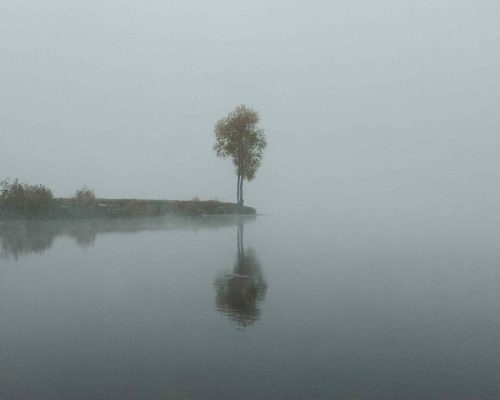
It is virtually impossible these days for us to imagine the silence of just 150 years ago. Not so much as a phonograph to spin music on demand, never mind a radio or – good heavens – earbuds tuned to Spotify. No motorized vehicles or tools, no humming appliances. Hours could pass with only the rhythms of organic life to punctuate them. From within our quiet-averse age, we wonder, “What on earth did people do?” I think they pondered.
Pondering is endangered too in our day. Oh, we may occasionally run up against an issue, a challenge, a decision that requires our careful consideration, and we may undertake to mull things over for a few hours or days. But there is a deeper and more elemental contemplation
that lives beyond the range of particular concerns, a pool where a bit of everything and nothing in particular swim together to engender wisdom. A pondering that lodges only in silence.
Picture ages past: the farmer at the plow, the craftsman at his workbench, the shopkeeper at his shelves; the mother preparing meals, the gardener tending green shoots, the nanny watching children play. They had so much time, with minds only partly occupied with familiar tasks – time for the content of life’s occasions and consequences and feelings to flow and settle, preparing the soil from which responses to life were born. The quiet against which life unfolded was as natural to them as breathing air – so natural that I doubt they fully grasped the luxury of room for mind and heart to roam open fields of possibility.
Neither do I believe that most 21st-century dwellers comprehend what we have lost, not only emotionally but especially spiritually. The Old Testament prophet Elijah heard God not in the wind, the earthquake or the fire, but in the still small voice that slipped in behind them. Spirit does not shout; she whispers. And no matter how we may try to filter the aural assault, each aggressive perforation of silence in our days inches us further from our natural habitat, from the contemplative ranges of being. From the ground where we meet God.
Pure Consciousness
For centuries Christian doctrine has held fast to the notion of a transcendent God extending grace across the divide to engage with humanity. But there has always been a minority report that described a more intimate scene of revelation. From their direct experience of the divine, mystics of every age have disclosed a cosmic divine presence more immediate and more dynamic than the Church was often willing to entertain. Even the mystics’ struggles to articulate that experience in light of prevailing theology suggest that a greater vessel was needed.
Though often labeled as “progressive” and resisted as unbiblical today, the idea of God as “pure consciousness” is not new to religious thought at all – not even to Christian thought. Śaṅkara introduced the concept to Hindu Vedanta in the 8th century, and 14th-century German Christian mystic Meister Eckhart discovered the God beyond being in his imageless prayer of contemplation. Each discerned an infinite and eternal consciousness as the seat of human consciousness. For Śaṅkara, the divine consciousness within humanity was the Atman, the nondual God in its manifest expression. Eckhart identified it with the imago dei, the image of God within humanity as the crown of creation. Both knew it as Reality itself, as Source and Ground of all life and creativity, present in human and divine as One. And both grasped that its essence is love, not as emotion but as Being itself, holding the promise of wholeness for each individual being and all of them together.
If indeed consciousness is where we meet this God, we might want to pause and consider how well we shepherd our own. It is no accident that the preponderance of mystics from all religions have been monastics. Within the cloister, custody over what flows into the mind and heart meets a profound silence in preparation to apprehend the divine and its counsel. And while fewer today may feel called to this formal embrace of silence, many still instinctually seek out the quiet in spaces set apart for retreat or in untrammeled places in nature in order to listen for the still small voice.
Nevertheless, more than one spiritual retreatant has discovered that an external silence may not readily make its way inside. The mind is restless; the heart is frustrated. Consciousness, it seems, does not respond on demand. It wants tending.
An Acquired Taste
The God of pure consciousness known by Śaṅkara and Eckhart and so many others is infinite and eternal, ever present, murmuring its wisdom and wholeness into our awareness. But our everyday receptive apparatus is finite and prone to obstruction and distortion. The past couple of centuries have done human consciousness no favors. The constant mechanical noise that unsettles the spirit does its own damage, but truly pernicious is the drill of information and opinions that drowns out divine whispers. As the mind grabs hold of what is most available, internal noise drowns out even the external, immersing itself in compulsive rumination on what is thrust upon it.
Rumination is the enemy of pondering, obsessing over details in its groping for control; the ersatz resolution of forced judgments quashes pondering altogether. We are encouraged to take a stand and declare ourselves; the natural maturation of judgment over time is labeled inconstancy. Human beings have ever sought security, but in the passing of pondering with the demise of silence, we have forgotten how to live in the process of knowing, a process that unfolds by stepping into uncertainty, that finds its way through lightly held choices, but that nevertheless trusts what is beyond the immediately known. And wisdom too slips away.
For as Spirit whispers, wisdom matures, and both call us to something more than the black-and-white choices the shouting world demands. In moving beyond the jurisdiction of mastery we are able to slow down, to heed the gentler signals that nurture insight and open wider the door through which the shared divine and human consciousness flows. Space is created for us to imagine more creative and loving ways of transforming the disharmony around us.
But silence itself must be cultivated. So habituated have we become to the thrum of modern life that silence has become an acquired taste. It is not that we don’t crave it, but that we are uneasy in it once we find it. For despite our expectations, the silence we seek – or the silence our souls need – is not the mere absence of sound. We look for respite from all that troubles the spirit. But if that deeper silence has always been elusive, when fewer threats to it came from outside, it remained within reach. The space around daily concerns and ultimate questions flowed more easily in and out of extended intervals to invite wisdom, in a natural pace of being and thinking and doing.
It will take time and practice to unlearn our addiction to the drone of voices vying for our attention. It will take courage to allow silence to temper our dependence on quick conclusions and easy justifications. In carefully maintained margins of silence mind and heart may rediscover their identity with divine consciousness as the source of the wise, creative and compassionate answers to the world’s hard questions. In a meditation practice, or a daily walk through the park at the edge of town. In the quiet evening spent with simple craftwork or great poetry. In a weekly sabbath fast from media. In simply hesitating before reflexively filling the silent spaces when we stumble into them.
It will take patience, something else we have lost the knack of. We must learn to wait in external silence for it to seep through the cracks in our armor. And finally, it will take trust that in such emptiness lies our surest access to the channel through which the one consciousness flows.
Not that our great-grandparents were aware of their pondering, in the hours when everything and nothing flowed through them. It was simply the way of life. But nor were its products evenly sapient. Wisdom is a process and its landing in any given moment is not guaranteed. Resentments and fears, the shadow side of silence, will find harbor too. Within the stillness, the voices we have tried to drown out scream all the louder.
In the Shadows
Silence is not magic. It will not instantly release the latch into the divine consciousness. At times, in fact, it may feel acutely uninspired. Spiritual teachers of every persuasion have counseled caution for novices in the work of silence. Remember John of the Cross and his dark nights of the soul. Silence discloses not only the good, but the bad and the ugly as well, revealing their true nature on the way out the door. Even – no, especially – if we are diligent in our attention.
Perhaps that is why so few of us begin, why we throw ourselves more energetically than ever into the work and play we manufacture in order to keep consciousness occupied and ignorant. The decay of our fortresses is not pretty, and the knowledge that they are ours is hard to escape in the midst of silence. But if we don’t face them within, we will face them without, in the brokenness they create around us.
Yet here too silence will do its work. We may need guides, both spiritual and professional, to help us negotiate the imbalances created as the anchors of false security are cut loose. But as we are released into a greater flow of consciousness, from divine to human and back again, pain and fear are transformed into opportunity. The more silence enjoys our good faith, the more we are free to ponder our way into the kinder, more just and more peaceful world revealed by its spaciousness as pure possibility.
Divine consciousness is both patient and impatient, always hovering to fill in whatever spaces we create for it. Silence is its partner – not an end in itself, but a companion on the way to its realization. Both do their work inexorably, no matter how imperceptibly or uncomfortably they come to us, winding tendrils of healing and hope through the spaces we create for them.
Silence takes us to the center – of both God and ourselves. We may come by other routes, along scenic detours or harrowing byways, but they risk the distractions to which we are all too susceptible. As monk and spiritual teacher Thomas Keating always said, “Silence is God’s first language; everything else is a poor translation.”
It will not force itself on you – God is like that. Its way will not always be easy – God is like that too. But within silence is the grace of pondering, of accepting what is, mixing it with what may be, and waiting in trust for wisdom to settle. And to be mixed up and settle again, over and over, as we make our way in the faith that we are going somewhere, somewhere transcendent, somewhere true.
We’d love to hear from you, please share your comments with Kaira below.