
Sept. 19, 2026
Life From the Desert:
A Spiritual Geography
It is no secret that many are walking away from the church these days. The trend that became visible in the 1960s has picked up speed in recent decades. Countless studies that have tracked the decline in religious affiliation have also made clear that many did not abandon a belief in God, but rather the institutions that claimed exclusive access to it. Yet if modern leavers may be heartened to learn that they have predecessors seventeen centuries old and tens of thousands strong, they may well balk at the challenge embodied by those whose leaving demanded absolute vulnerability and unflagging commitment.
Historical shorthand has named them the “Desert Fathers,” but historians now know the movement to have comprised significant numbers of women; some think the gender counts may have been nearly equal. Though the title has become most closely aligned with the hermits who lived in huts or caves, from early on the majority lived in primitive monasteries or semi-communal arrangements of cells. Whatever the gender make-up or configuration of settlement, the conditions for those who retreated to desolate regions of Egypt, Syria, and Palestine required a singular combination of grit and devotion to persevere in an unforgiving regimen of simplicity, silence, and solitude.
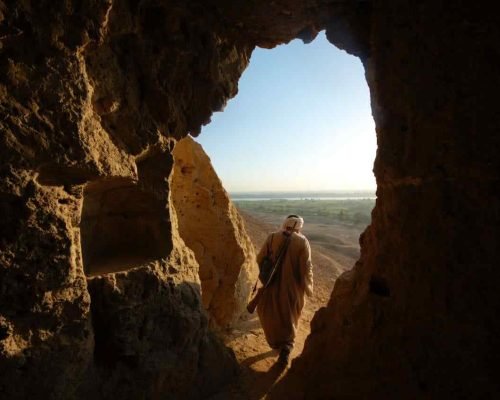
What could possibly have sparked a fervor that courted such radical renunciation of personal status and security? The seeds of withdrawal were sown in the flight from Roman persecution in the mid-third century undertaken by perhaps a few thousand. But paradoxically, the movement exploded in response to the legalization and patronage of Christianity roughly sixty years later. And these later refugees fled for their lives no less than the early ones.
Once Christianity became legal, its critical character as a protest against wealth, status and power began to erode. The clarity of Jesus’s vision of a world ruled by love and sacrifice, by the emptying of self-interest into service, was gradually subsumed into theological and ecclesiastical definitions that softened the demand to live as Jesus lived. Imperial patronage flooded the church with converts whose motivations were far more mixed, blurring the line between the kingdom of God and the empire of Rome.
The desert as the locus of any kind of kingdom underlines the contrast. There was nothing magical about retreat to its particular landscape, but these unpopulated sites were instead emblematic of the desire to escape the pressures and influences that societal norms inevitably exert. But even as we may recognize their challenge to our own accommodation to the status quo, we face stronger headwinds. Fewer remote places remain to which to flee; little precedent and few models remain to confront our complacency.
Stepping Apart
Complacency was, of course, one of the fears that motivated the departure to the desert. Daily life offered few of the comforts and conveniences we enjoy today, but the predictability of an established mode of being was no less compelling. Desert existence put these men and women on the edge not only of civilization, but of survival. It was a matter of principle that they owned nothing. They eked out a subsistence by tending small garden plots and weaving baskets to sell for other needs. They ate once a day at most, frequently fasting for days at a time. One might go weeks without speaking to another person. But if we are inclined to label these men and women extreme or fanatical, we will miss the spiritual reality that sat at its source.
For the desert fathers and mothers did not pursue austerity as an end in itself, but as the means for clearing out the distractions that stood between themselves and a direct apprehension of the divine. They courted the same union with God that Jesus knew and manifested; they sought the same singularity of purpose that is the foundation of the kingdom of God.
In days and nights spent memorizing and ruminating on large swaths of the Gospels, these early monastics sought that encounter by meeting a living Jesus in the stories that witness to his wisdom teaching and his compassionate action. They meditated on passages not to discern doctrinal or moral absolutes, but to release the scriptures’ “hidden” or mystical truth—a truth that lived beyond articulation of creeds, in the union with the greater Spirit at the heart of the created world. They sought a truth that would fill them and animate them in every moment—in every thought and action—embracing the kingdom of Jesus’s imagination with their very souls.
As I picture these solitary characters absorbing the metaphors Jesus employed to limn the kingdom, I have to believe that his admonition that “it is easier for a camel to pass through the eye of a needle than for a rich person to enter the kingdom of God” would have held particular significance. They had already taken this caution to heart, as the very baseline of their quest. It is impossible to know how explicitly they might have drawn its lines, but an implicit premise is clear: that a life of faith, of following Jesus’s example, could never survive in alignment with a political system. Faith would always be political precisely in its freedom from the control exerted by and the comfort bestowed by any camp of ideology.
Stepping Inside
Though there is some historical documentation of this massive movement, most of what we can know of the life and faith of the desert fathers and mothers is gleaned from the Apophthegmata Patrum, the Sayings of the Desert Fathers, that were collected first orally and then written down, beginning in the fourth century. These sayings, grouped according to the elder with whom they were connected, themselves demand a high price of entry. Brief and pithy, they appear at first glance to fit the ages-old wisdom carrier known in all traditions. But a closer look shows them to be a very peculiar sort of koan. They are enigmatic, to be sure, puzzles to be pondered rather than parsed. Yet they are also braided with common sense and practical counsel. Their feet are planted in the soil of daily life, but sprung from particular experiences at which we can only guess. The Sayings demand that we slow down, step back, step out of the assumptions that form our automatic modes of being. They ask us to look for the why and the how rather than the what.
And when we follow them into their singular realm of communion, a number of things become clear. Sacred scripture was to be prayed, not argued over. Doctrine was not denied, but neither was it debated. Every truth that sat upon their lips was offered to a particular person facing a particular dilemma, at a particular stage of spiritual growth, on a particular occasion. The vocation of these elders was not one of preaching, but of guiding, trusting the inner light of the seeker. Their presence was that of the Indian yogi or the Zen master, an invitation, a door into the more offered by the universe and the divinity that pervades it. And the foundation that held up every instance of the monastic charism was the charity and hospitality that mirrored Jesus’s own, that welcomed and never coerced, that loved and never condemned.
What a contrast these forgotten giants offer to contemporary models of moral and ethical righteousness. The only power they sought to exert was the force of humble example, sharing freely what small wisdom they had earned and trusting truth itself to win the kingdom of love. A kingdom, a society, a reality lived on the ground, built from the soil of love upward, not imposed from above.
In our day, encased in structures of government, religion, education and business, we have almost entirely forgotten that there are alternatives dormant in the miraculous phenomenon of humankind that has flowed from the immense Creativity unfolding in the universe; we have certainly not been encouraged to seek them out. The driving force of the desert mystics was this now nearly invisible flicker of hope: the call not to become something extraordinary, but to become completely themselves, to embrace and embody the imago dei, the image of God that seeks expression in each life according to its gifts, that promises transformation of the world in each emerging occasion.
The hope that the world needs in our day is not the discovery of the right ideology or system or moral code, but the growth of the seed planted within each one of us as the love that moves mountains. It is small wonder that the stream of protestors to barren places apart was seen by Rome as defying its power and by the church as undermining its authority. The kingdom that emerged in the desert was one that did not depend on a might that could be matched and overpowered, but one over which no state can preside. It is the kingdom that arises unseen except by those who receive its blessings within the communities of love that are its vessels.
Stepping Forward
Our twenty-first century world pleads for such a kingdom of love, in screams of silent despair and keening need. The protest begun a century ago in declining church attendance is only the symptom, the diagnostic first tread into healing. The key is not in the leaving, but in the destination. Without discerning the site of our desert pilgrimage, we will wander an even greater wilderness.
Yet neither need the prophet of transformation abandon the vehicle that has borne Jesus’s story, if not always his heart, down the centuries. True resistance requires prophets who can occupy the center while answering to the margin, offering the very baseline of non-cooperation from within the gates.
The shape of our failure to heed Jesus’s example is radically different from the one discerned by fourth-century monks. We must both learn from their courage and transcend their witness to raise a new paradigm of human participation in the Ultimate Reality that holds divine and human in a single embrace, in nondual Oneness. One that can and will be built only by taking one step at a time, one compassionate thought and act at a time, flowing into a great current of transformation.
We may not claim the greater complexity of the world today as an excuse to avoid the task. The test comes not in confronting externals, but in offering up our addiction to them as ersatz vehicles of security, and trusting in the power born in imago’s Source. The choice always comes down not to the size of the obstacle, but to the size of the heart.
Abba Joseph, a primary figure in the Apophthegmata, offers us an unequivocal last word. Read on, if you dare.
“Abba Lot went to see Abba Joseph and said to him: ‘Abba, as much as I’m able, I say my little office, I fast a little, I pray and meditate, I live in peace, and as much as I’m able, I purify my thoughts. What else can I do?’ Then the elder stood up and stretched his hands towards heaven. His fingers became like ten lamps of fire and he said to him: ‘If you want, you can become all flame.’”
We’d love to hear from you, please share your comments with Kaira below.