
Oct. 16, 2026
Reverence:
The Abandoned Compass
I challenge you. Name something about daily life that doesn’t feel out of control these days. Or maybe barely under control. News reports put labels on our fears, but we scarcely need reminders. Climate change, artificial intelligence, and rising autocracies are simply the high-level manifestations of a panic that lives just under the skin. But even if the reins were in our hands, honesty would require us to admit that our imagined solutions are not immune from the limited vision of our particular moment in time.
For long ages in our past, few apart from putative God-Kings presumed categorical power to manage reality. The world was simply too unpredictable. Gods ruled by inscrutable decree; even geological and historical events were ascribed to divine sanction rather than to the natural consequences of life on the ground. A reverent bearing was built into the means of survival, a prudent attitude, to be sure, but more deeply rooted in the nature of human experience.
Yet history is also the story of growth and change, of the increase in the number and sophistication of tools for understanding and managing our environment, and humankind’s embrace of advancing knowledge was surely
warranted. What bears another look, however, is the equally powerful human tendency to forget the ethos that made progress possible: the ability to see what is for more than how we can exploit it, the capacity to see in the cosmos and each of its expressions something far grander than an opening for present ease and gratification.
And that brings us back around to that sticky matter of control, for many of the fears we carry today are the product of ill-advised and misguided efforts to grant a more final status to our state of knowledge than it warrants. It is one thing to act upon the best of what we know; it is another to act as though there is little left to be discovered. Or that we can ever have the whole picture.
Being and Delight
It is a tricky balance, certainly. Survival is our genetic blueprint, and we have grown up—both individually and as a species—in a world that can seem disinclined to support our well-being. Yet were the exercise of our agency confined solely to perpetuating existence, its impacts might remain limited. It would seem that we aim for more—for a fuller and richer experience of being. Is that, too, baked into our genes?
From the beginning, we welcome the unexpected. A young child drinks the world. Everything is new; everything is full of wonder. Each morsel of experience comes steeped in the mystery of the unknown, perched on the edge of revelation and prized for its own sake. She respects the hidden; he expects surprise. Think for a moment of the child’s reaction to discovery: startled, bewildered, then delighted. And the contagious laughter that we cannot stop watching.
The child’s learning process is anything but pragmatic. It reaches in all directions; it accepts all comers. But filters are on their way in as well. Growth beyond the relative security of home and family requires the capacity to discern what gives life and what threatens it. Delight becomes tinged with pragmatism, and our connection to the world that offers it is overcast by an increasing burden of self-protection.
We do not live on delight alone. So may we justify our utilitarian agenda. And so do we jeopardize the very stream of abundance beneath our wings.
Knowledge and Mystery
All along the centuries of humanity’s advance in knowledge, societies large and small created ways to sustain and honor the unknown. Rituals both private and public stepped back from the quotidian particular to mark the inscrutable universal—the rotations of the earth, the movement of seasons—shaping myths of beginnings and endings of which life, and lives, are comprised. Daily rituals and yearly rituals, secular rituals and religious rituals, built from actions at once familiar and symbolic, kept open a space of reverence for the mystery just beyond our grasp. The mystery that is its own reason for being.
The mystery that is the font of knowing itself. Just as the child learns to shape delight into tools for living, so did cultures shape themselves around the invitation to plumb the universe for the means to enhance life within it. Yet somewhere along the journey, as knowledge filled in spaces on reality’s map and created expanding pockets of security and comfort, humankind became seduced by illusions of mastery. As we became better and better at it, the seeds of a zero-sum calculation were sown, reverence forced out of the game. The forest was lost for the sake of the trees.
Where is the line, I wonder. When does the child’s delight become merely practical? When does science cross from curiosity and wonder into expectation and manipulation? When does spirituality shift from awe and hope toward authority and certainty? At the line, I suspect, where reverence for mystery is abandoned in favor of a more apparent assurance. Where we forget who we are—participants in the mystery itself.
It is perfectly understandable, of course. Life seeks not just to survive but to thrive, to grow into new expressions, but the process on the ground is not tidy. It finds its way among the changes and choices that populate history books—in fits and starts, in great trial and ghastly error. In fact, it should strike us as extraordinary, were we to stop and consider it, that throughout nearly four billion years of life on earth the thread has not been lost. That life has continued, and continued to grow, in a kaleidoscopic manifestation of restless harmonies, no matter how messy it looked in a single frame.
Or did, until we ourselves lost the thread. The evolutionary stream of life’s becoming has resulted in us, in self-conscious beings capable of knowing the remarkable power we carry. But perhaps we became so enamored of our singularity that we were seduced away from the very mystery within which we arose. For however Western philosophies have framed us as the pinnacle of creation, everything we know about the cosmos suggests that it is not finished. Creation is not about us, but about that to which we may give birth.
That is a much more exciting proposition than the manipulation of a preexisting universe. And a more daunting one. One for which we need to rediscover true north.
Reverence and Road
Religion is may not be that compass either. Not that it has not offered us many points to steer by along our way. Each of the great religions—and many more local ones—grew from the wisdom of a few who glimpsed the greater terrain, whose reverence for the whole shone new light on a single shared reality. And while not everyone who recognized the light in those few was able to discover it in themselves, these luminaries left markers on the path. Examples, parables, teachings.
But the religions that grew from them ran the same risk as the good-faith followers of science: that the allure of certainty would obscure the lure of mystery, that the delight of discovery would be overcome by the desire for security. Religion may become but one more tree, overweening confidence in a particular set of beliefs taking the place of the reverence for, surrender to, the forest to which they were simply meant to point.
If science has become the compass of modern culture, the course correction will not come from making of religion a rival one. We must, as one of my old theology professors used to say, avoid the ditches on both sides. The road we need goes straight through the forest, into the dark density where nothing may be ignored, nothing elevated.
There is scant room for reverence in a world bent on mastery, but it may be the very thing that is needed if we are to find our way out of the messes we have made. Reverence has been squeezed out of the conversation along with mystery, reserved for categories of the sacred, granted to the unexplained or extraordinary. This or that experience evokes reverence; this or that person earns reverence. And all we are left with are trees.
When we reserve reverence for things we deem holy, we make it one more means for control; we strip its power to reorient us, to relocate us within the landscape of becoming. For reverence is not reserved for the sacred; reverence reveals the sacred. In the light of reverence, all is seen for what it is; all is discovered as the flow of the divine into the world, to be valued for its own sake before it is engaged for its, and our, becoming. The enemy as well as the friend, the wages of war and the prayers for peace, the partial truths from which we manufactured security and the more complete truths that challenged us beyond our willingness to trust them—all have arisen from the spring of creation in which we live and move and have our being.
The choice before us is not what to reverence, but whether to step into reverence. Within reverence, our challenges may be seen not as problems to be solved or circumstances to be controlled, but as signs pointing toward a vital reintegration of pieces broken off from the whole, of life lifted from its mystery. Perhaps for the first time, we will discover our true task: to move from delight to wiser delight, to create from fullness to greater fullness.
A poet once wrote that the road is made by walking. Yet navigation has never been more difficult. The balance is heavily weighted in the direction of the known—or more aptly, the partly known. We drown in implied possibilities and limitations, unaware that the greater part of the picture is missing. In a world as complex as ours, it may never be much easier. Yet our steps might be more considered and more measured, less fearful and less frantic, if we knew we were building eternity. If we trusted that what we see is but a fraction of what is. Perhaps our gaze would take in less of our fears and more of our hope. Perhaps we would see that the key to the whole crazy, troubling, delightful, scary thing is always with us, in the reverence that shines light on the road. The reverence that builds the road.
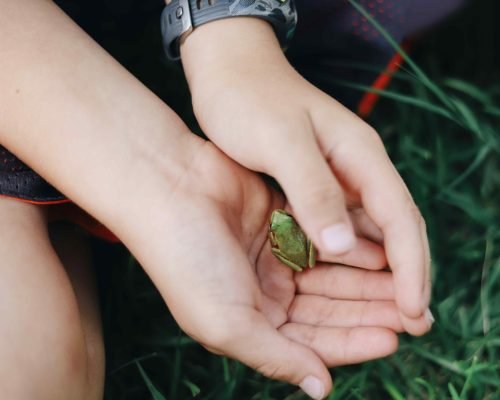
The scientist whose gaze expects the unexpected. The mystic who sees the world as a hazelnut in God’s hand. The child who welcomes the unknown. The world is not ours to engineer, but to know in deepening waves of reverence for its possibilities. Our bearings are there if they are anywhere, in the step back from self, in the step into the all. In both the humility and the courage to embrace our role in a creative cosmos. In the vast space for moving through and beyond our present challenges that opens when we make space for awe.
Real space, space in our time, in our attention, in our gathering. We must find it and we must create it. It will look as different from the ritual of our ancestors as does our view of the universe. We will carve it from our current cosmology and weave it into our own shared spaces. But it will serve the same transformation sought by every generation—a way beyond our fears, a way beyond our control, a way beyond even our imagination. A way through the trees, with a compass for our step back into the mystery.
We’d love to hear from you, please share your comments with Kaira below.